What Are Those Little Strings on the Sail? The Engineering Behind Telltales
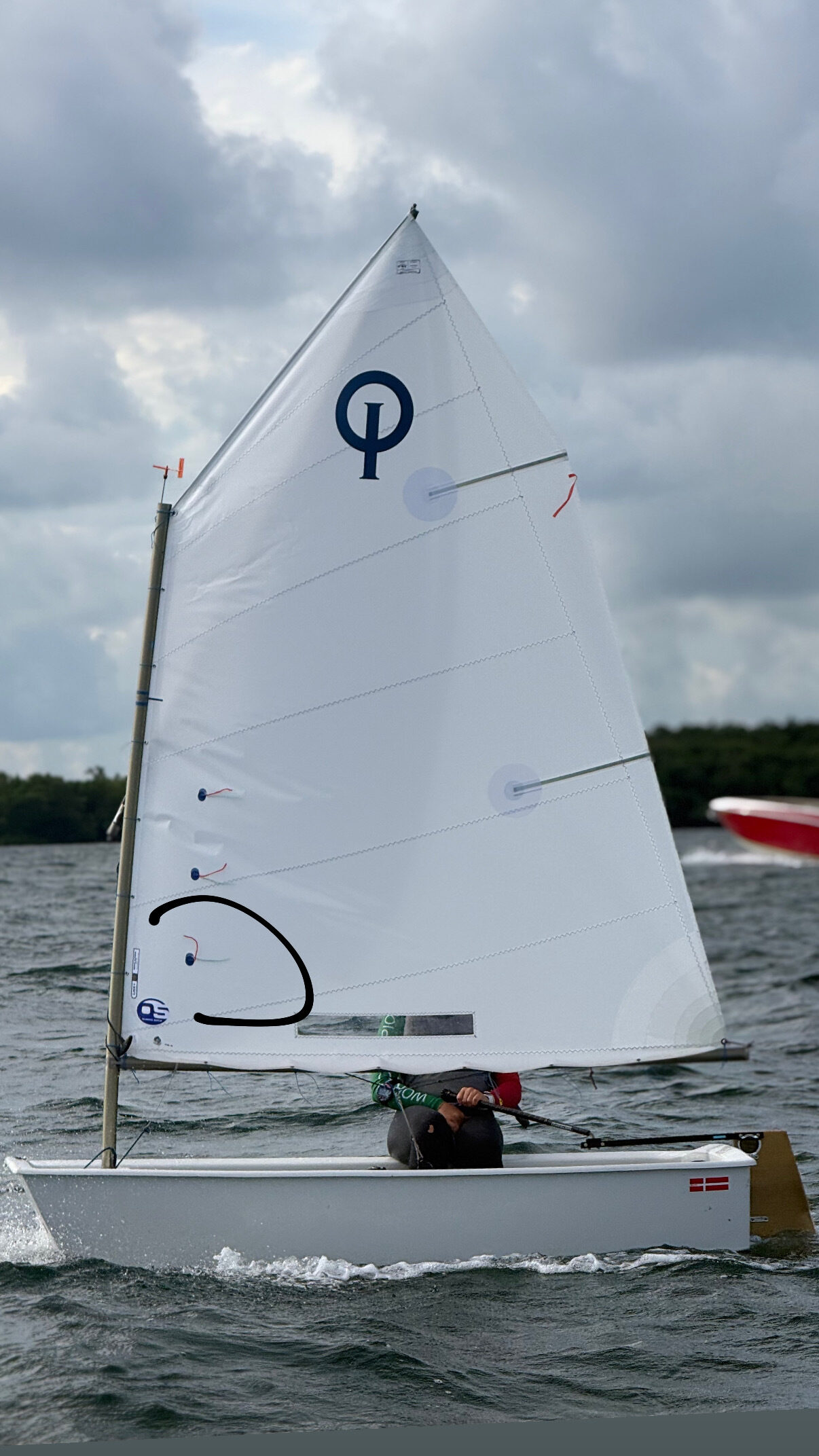
The sail is a wing
A sail works like an airplane wing standing upright. The wind flows around it, creating higher pressure on the windward side and lower pressure on the leeward side. That pressure difference is what pushes the boat forward. But it only works if the air stays in contact with the sail.
What a telltale actually measures
A telltale is a light piece of yarn attached at one point. It has no motor and no memory. It points wherever the air right next to the cloth is moving. That thin layer of air, usually just a few centimeters thick, is what engineers call the boundary layer, and it decides how well the sail performs.
Why they fly straight
When the air follows the sail smoothly from front to back, the yarn lines up with it and streams straight, like a flag in steady wind. Engineers call this attached flow. When the air stops following the sail, the yarn jumps, droops or spins. The wind didn’t change. The flow separated from the surface, and the sail loses power.
An easy picture: water around a rock
Imagine a river flowing into a rock. The water splits and goes around both sides. With the right angle, it slides past smoothly. With the wrong angle, it splashes and swirls on one side. The front edge of the sail works the same way, and the telltales show which side is “splashing.”
Why there are two sides
There’s a telltale on each side of the sail. Each reports on its own side, so a sailor can tell not just that something is wrong, but where.
The engineering behind it (optional deeper read)
- Angle of attack. The point where the air splits at the front edge of the sail, the stagnation point, moves as the angle between the sail and the wind changes. Too small an angle and the flow detaches on the windward side. Too large and it detaches on the leeward side.
- Why the air lets go. On the leeward side, the air speeds up around the front edge, then has to slow down as it moves toward the back of the sail, where the pressure rises. The air closest to the cloth has the least energy. If that pressure rise is too steep, it stalls and even reverses. That reversal is what the telltale shows. Engineers call this an adverse pressure gradient.
- Attached is not the same as laminar. A streaming telltale tells us the flow is attached, not that it is perfectly smooth. At the speeds and sail size of an Optimist, the flow near the surface turns turbulent after a short smooth stretch. A turbulent flow that stays attached still keeps the telltales flying. My rough estimate of the Reynolds number for an Optimist sail in normal wind is a few hundred thousand, which is the transition range.
- Why separation costs speed. When the flow separates, the sail produces less force and creates a turbulent wake behind it, which adds drag. Less drive and more drag means a slower boat.